Method Comparison Study
Missing Details: The Hidden Cost Driver
Executive Summary
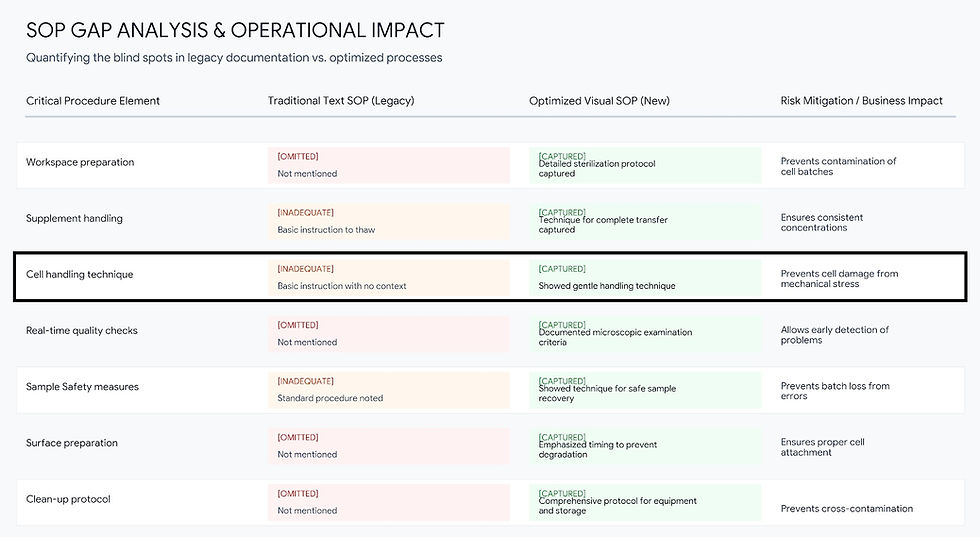
This case study compares a biotechnology organization's traditional text-based SOP with Method Made's enhanced multimedia SOP for a cell culture procedure. The analysis reveals that Method Made's solution captured essential procedural details in 7 out of 13 steps (54%) that were completely missing from the traditional documentation.
Industry Context: The Cost of Knowledge Gaps
100 discovery conversations with Process Development Engineers/Scientists indicate:
-
Scientist time for knowledge transfer costs $150-250/hour
-
Tech transfer consultant's time costs $300+/hour
-
Traditional SOP creation and training consumes 20-40 hours of senior scientist time per procedure in startups and small CDMOs
-
Tech transfer timelines increase the more people involved:
-
startup IP owner to small CDMO are generally fastest, inter-organizational across borders in big pharma are slowest
-
each additional person involved is an additional potential communication failure risk
-
-
A single assay tech transfer routinely costs $50,000-100,000+
-
Transferring a technology to a CDMO routinely involves 100+ laboratory SOPs
-
Companies typically lose 6-12+ months of productivity in back-and-forth communication to identify and align on missing procedural details during a typical tech transfer
-
The cost of a single repeated engineering run due to procedural errors can exceed $180,000
-
Engineering runs routinely repeat multiple times due to missing procedural details.
-
Companies that skip engineering runs due to investor timeline pressure risk $3M+ per batch in costs to do process development at scale
Method Made's approach can significantly reduce these costs by improving knowledge transfer efficiency through procedural detail capture
The Challenge: Critical Knowledge Lost in Translation
The organization, like many biotech organizations, relied on text-based SOPs to document their critical cell culture procedures. While these documents provided basic procedural steps, they failed to capture the tacit knowledge and nuanced techniques that experienced scientists develop through years of practice.
Cell culture procedures are particularly sensitive: small variations in technique dramatically affect cell viability and experimental outcomes. Yet the standard documentation approach lacked the detail necessary to consistently reproduce optimal results.
Approach: Documenting What's Done vs. What's Written Down
Method Made implemented its video-enhanced SOP system to capture the cell culture procedure exactly as performed by the organization's experienced scientists, and compared it against the SOP from the organization which was documented using traditional authoring methods by the same author, for the same procedure at the same organization. This provided an apples-to-apples comparison between:
-
What was documented in the text-based SOP
-
What was actually performed by Subject Matter Expert
-
The critical gaps between these two information sources
Key Findings: The Invisible 54% of Procedure Knowledge
The analysis revealed seven major categories of critical information completely absent from the traditional SOP:
Regulatory and Compliance Implications
Documentation gaps like those identified create significant regulatory risks:
-
If regulatory inspectors discover these gaps instead of internal teams, companies face potential 483 observations
-
"If it's not documented, it didn't happen" is a fundamental regulatory principle
-
Verbal knowledge transfer is not recognized by regulators as valid GMP documentation
-
Proactive documentation improvement is significantly less costly than reactive remediation under regulatory scrutiny
Conclusion: The Hidden Value of Visual Documentation
This case study demonstrates that traditional text-based SOPs captured only about 46% of the actual procedure knowledge. The remaining 54% - consisting of technique nuances, quality checks, and context-specific adaptations - represents the difference between consistently successful outcomes and frequent, costly failures.
Method Made's approach bridges this critical knowledge gap, creating comprehensive procedure documentation that captures both what to do and how to do it. This allows organizations to:
-
Free senior scientists to focus on innovation instead of repetitive training
-
Enable junior staff to work independently with confidence
-
Maintain consistent results across operators and batches
-
Create a permanent record of institutional knowledge
-
Strengthen regulatory compliance posture
Business Implications
Training Costs
New team members struggle to learn procedures from text-only SOPs, requiring 20+ hours of hands-on training from senior scientists. This diverts valuable expertise from high-value research and development activities to basic training functions.
Tech Transfer Costs
Documentation gaps in tech transfer cost pharmaceutical companies $50,000-100,000 per incident, or $180,000 per engineering run. For small startups working with CDMOs, resolving a single documentation issue requires 20-40 hours of back-and-forth communication.
For larger organizations, tech transfer routinely stretch into a 6-24 month process of continuous communication between sites, with senior scientists diverted from innovation to troubleshooting.
Technical Risk
Our analysis shows that 54% of critical procedural details are performed correctly but never documented in official SOPs. This creates significant risks:
-
Unchecked errors compound as they move through production systems
-
Process variability increases with each transfer or staff change
-
When key employees leave, their tacit knowledge—the critical "how to" details missing from standard documentation—leaves with them
Our solution bridges these gaps, capturing the crucial details that traditional documentation misses and providing clear visual references that reduce misinterpretation, accelerate knowledge transfer, and protect your intellectual capital.
From Technical Gaps to Bottom-Line Effects
-
Senior Scientist Time Recovery
-
Senior scientists freed from repetitive training supervision
-
When junior staff encounter difficulties, they consult the video documentation rather than interrupting high-value research work
-
Knowledge transfer becomes asynchronous, allowing senior staff to focus on complex research challenges
-
-
Procedural Quality Improvements
-
Clear visualization of critical techniques previously undocumented
-
Comprehensive coverage of tacit knowledge previously only transmitted verbally
-
Visual reinforcement of proper technique for safety-critical steps
-
-
Long-term Knowledge Preservation
-
Protection against knowledge loss when experienced staff depart
-
Consistent onboarding reference regardless of who conducts training
-
Permanent visual record of best practices for future reference
-
Business Value
-
Protect high-value research time
-
Senior scientists can focus on complex research challenges rather than repetitive training
-
-
Eliminate knowledge silos
-
Capture expertise before it walks out the door with staff turnover
-
-
Reduce troubleshooting time
-
Clear visual reference points for resolving procedural issues
-
-
Minimize training variability
-
Ensure all staff receive identical procedural instruction
-
-
Strengthen compliance posture
-
Demonstrate thorough documentation practices to regulators
-